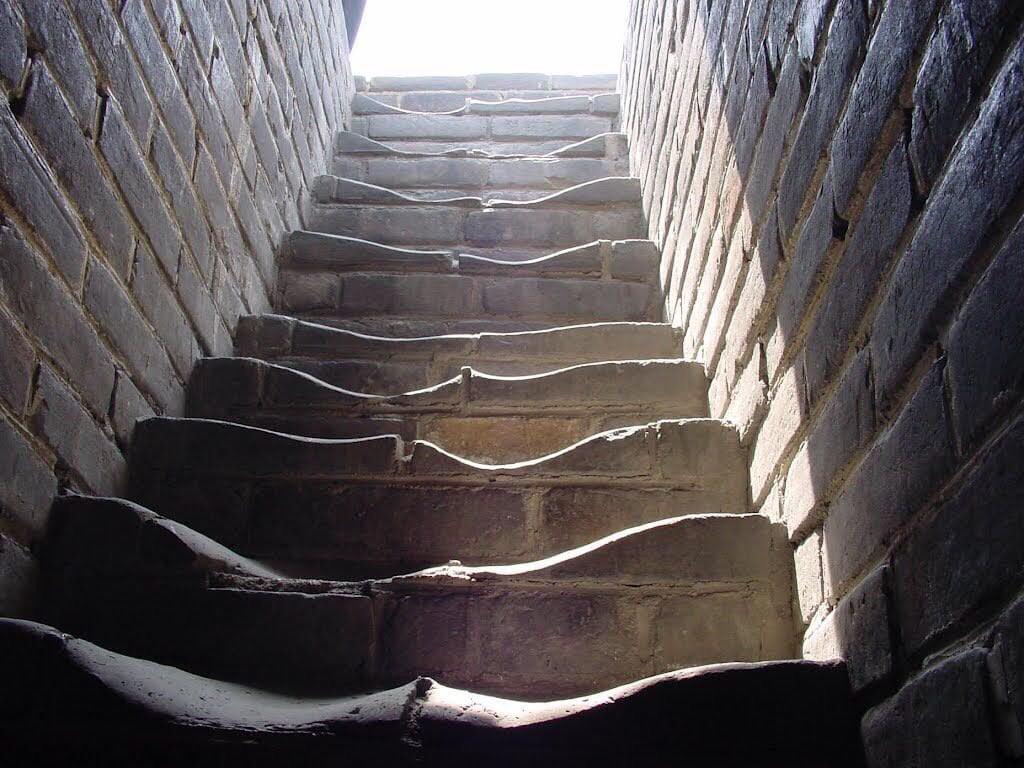
We analyze worn stairs in historical structures to extract information about their age, usage patterns, and renovations. Key questions we explore include:
Each stair step is used by a single foot at a time, exerting vertical force:
\[ F_w = mg = 62 \times 9.81 = 608.22 \text{ N} \]
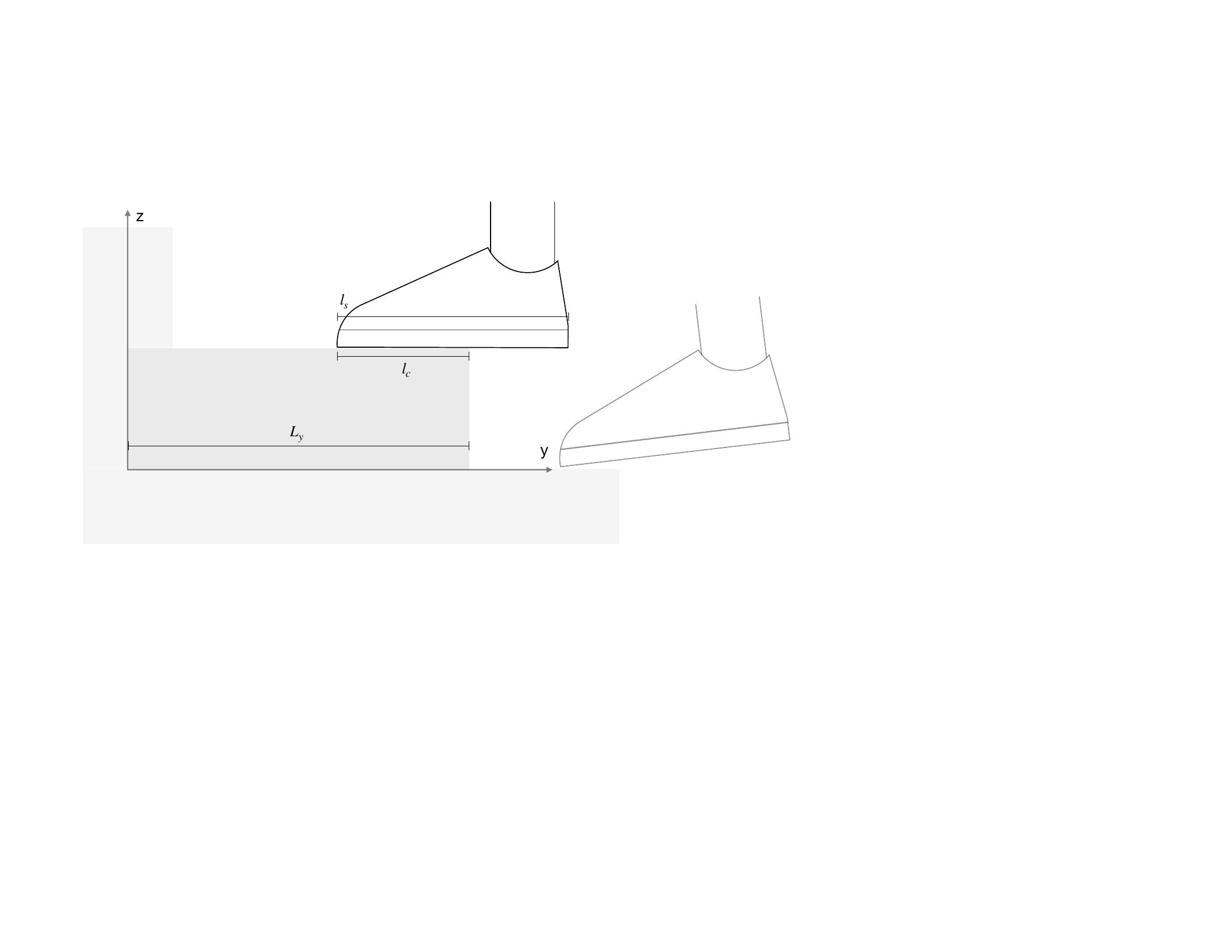
Contact area (including shoes): \[ 0.105 \times l_c \text{ m}^2 \]
Pressure applied on the stair:
\[ P(l_c) = \frac{608.22}{0.105 \times l_c} \text{ N/m}^2 \]
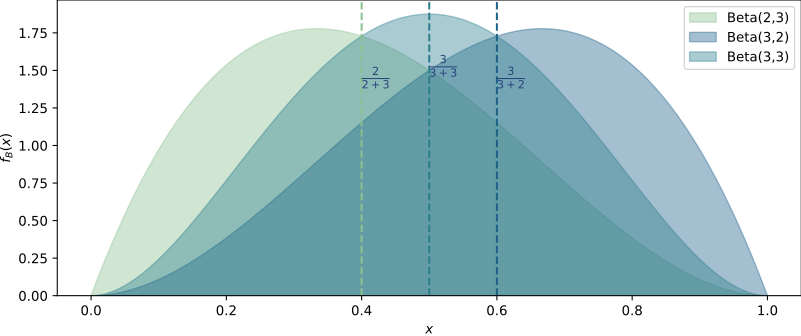
Stepping behavior follows a Brownian motion-inspired probability distribution:
\[ B_1 \sim \text{Beta}(\alpha=2, \beta=5), \quad B_2 \sim \text{Beta}(\alpha=5, \beta=2) \]
The deflection function follows the Euler–Bernoulli Beam Theory:
\[ \frac{d^2}{d y^2}\left[E I \frac{d^2 w(y)}{d y^2}\right]=q_0 \]
for \(E\) represent the Young's modulus \(I\) refers to the second moment of area about the neutral axis parallel to the width, \(w(y)\) is the deflection of the beam in the \(z\) direction.
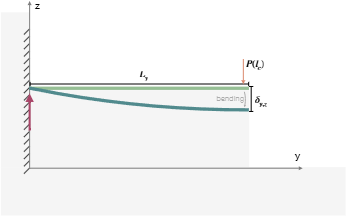
By our assumption, \(l_y\) is short enough to step only once on the tread. The original point-load Eu- ler Bernoulli beam equation is an over-simplification if combined with our SSFP model, because the length of the foot is usually significant compared to the length of the tread. If we apply the standard approach using a uniform load partially distributed beam method, the solution, as we verified, also does not blend with the nature of our SSFP Model well since the beam only deflects in a fully smooth way.
We eparate the 1D beam intotwo regions and construct piecewise functions accordingly:
\[ q(x) = k \cdot w(x) \]
where \( k = \frac{E}{t} \) represents spring stiffness.
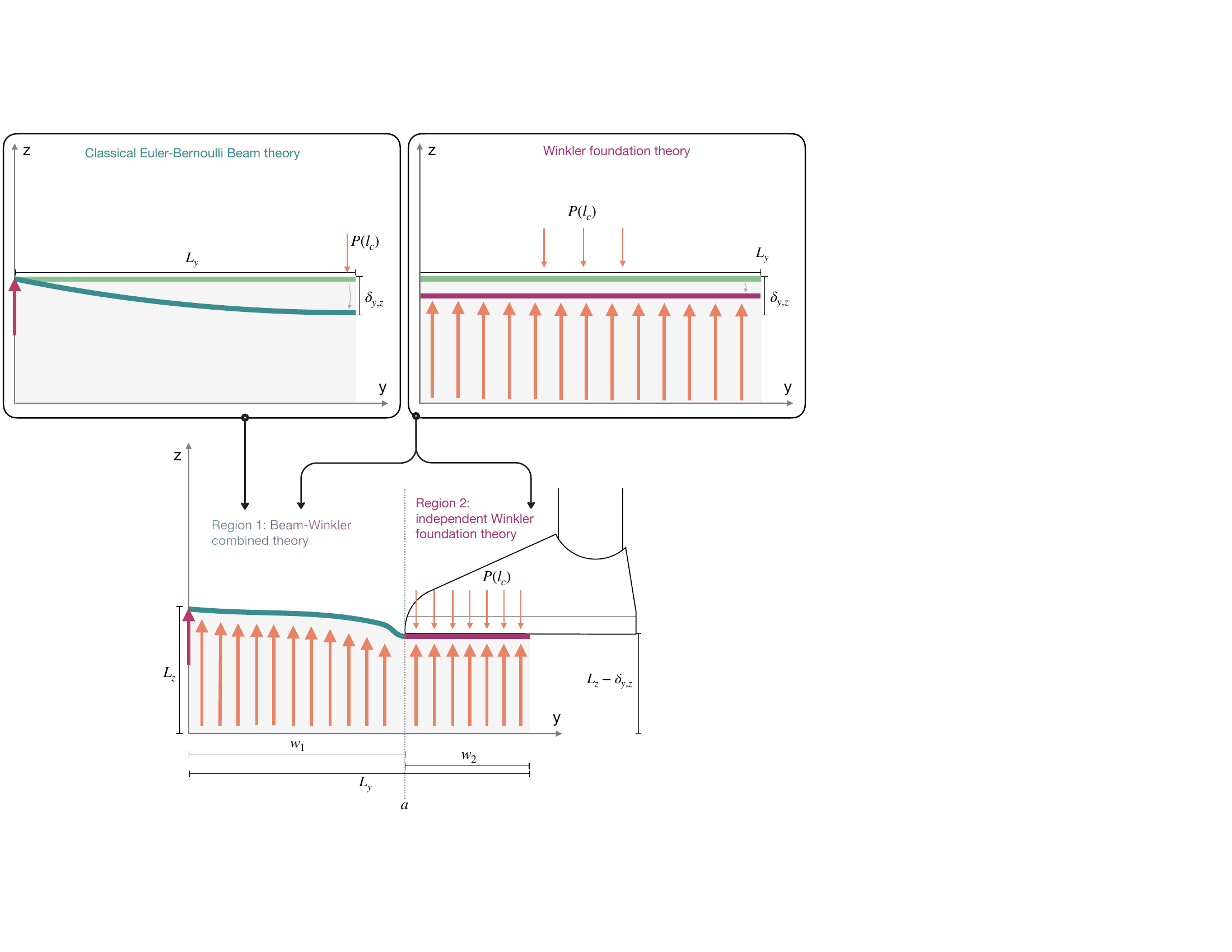
We believe this is an excellent choice because Winkler’s model assumes no shear interaction or displacement coupling between adjacent points. When the deformation of the tread is extremely small (which is the scenario for our SSFP model), the interaction between adjacent points be- comes small as well. It is reasonable to approximate, that when under tiny deformation, material non-linearities like plastic deformation, and rupture, are negligible
The formula of HEW formulate as below:
ODE:
\[ EI w_1^{(4)}(y) + k w_1(y) = 0, \quad y \in [0, a] \]
Boundary Conditions (BCs) at \( y = 0 \):
\[ w_1(0) = 0, \quad w_1^{\prime}(0) = 0 \]
Continuity Conditions (CCs) at \( y = a \):
\[ w_1(a) = \frac{q}{k}, \quad w_1^{\prime}(a) = 0 \]
ODE:
\[ q (L_y - a) = k (L_y - a) w_2 \]
Solution:
\[ w_2 = \frac{q}{k}, \quad y \in [a, L_y] \]
Based on the basic HEW model, we add two corrective terms: one is Archard-Wear Law and the natural factor.
One important correction factor we need to consider is the frictional force on the contact area that results in the loss of volume. We use the empirical relationship Archard-Wear to quantify the volume of material removed due to wear. For simplicity, we assume the deflection and height lost are additive over region 2.
\[ \Delta V_{worn} = K \frac{(F_{fric} \cdot S)}{H} \]
Incremental depth loss per step from Archard's relation :
\[ \Delta h = \left( \frac{K}{H \cdot A(l_c)} \right) \cdot (\mu q) \cdot S \]
We propose that the natural erosion of stair structures is influenced by multiple environmental factors, including time since construction, temperature fluctuations, humidity levels, and wind erosion along stair edges. The erosion model is given by:
\[ A_{Natural}(y,t,H,T) = Stiffness Factor \times (\alpha t^{\beta} + \gamma e^{\delta H_t} + \eta |T - T_{ref}|) \times f(y) \]
Where:
The erosion effect due to time, humidity, and temperature depends on the material’s stiffness, defined as:
\[ Stiffness Factor = \frac{1}{(1 + E_{material})} \times 10^{11} \]
where Ematerial represents Young’s modulus of the material. As stiffness increases, the erosion rate decreases.
The effect of wind-induced edge erosion is modeled by:
\[ f_e(y) = 1 + k \times (e^{-(y-1)/\sigma_y)^2} - 1 \]
Where:
As y increases (approaching the stair’s edge), fe(y) also increases, indicating greater erosion intensity near the edges due to wind and rain exposure. This is similiar to real situation since the edge of the stair is usually more smooth than the inner part.
A linear combination of Hybrid Eular-Bernoulli Winkler (HEW), Archard-Wear Law, and natural factors presents The final deflection HEWAN function \(W(y)\) of the extracted beam:
\[ W_{HEWAN}(y) = \left\{ \begin{array}{ll} w_1(y) + A_{\text{natural}}(y, t, H, T), & 0 < y < a \\ w_2(y) + \Delta h + A_{\text{natural}}(y, t, H, T), & a < y < L_y \end{array} \right. \]
Based on the simulation of HEWAN model, we are able to use backward analysis to trace back the information of stair, including: age of stair, material, pattern of use and so on.
Back to Projects